Showing posts with label History. Show all posts

Monday, December 12, 2011

The best preserved Roman city in the world


The most interesting thing in Libya is not a conflicting image of Muammar Gaddafi. In the center of the cradle of civilization will find ancient history and outstanding nature. The ancient city of Leptis Magna was one of the most prominent and cities of the Roman Empire. Its ruins are located in Al Kums, Lebanon – 130 km. east of Tripoli.


The city probably was founded in the 6th century BC by Phoenician colonists under the aegis of Carthage and became a major force in the Mediterranean. Lebanon is not an easy country to visit, but the magnificent Roman site of Leptis Magna makes it well worth the effort. The city remained under the dominion of Carthage to the end of the Third Punic War and then passed to the Roman Republic. At the time of Julius Caesar in the city live 100 000 people. Leptis contains some of the world’s finest and well-preserved remains of Roman architecture in the Mediterranean. In 1982 it was designated a UNESCO World Heritage site.

The birthplace of Nicolaus Copernicus


One of the oldest cities in Poland, the medieval town is the birthplace of Nicolaus Copernicus. In 1997 the history center of the city was designated a UNESCO’s World Heritage Site and the Old Town was added to the list of Seven Wonders of Poland.


Archaeologists have discovered that the first settlers in the area were over 1100 BC. In 1230 Teutonic Knights built a castle on the site. In 1263, Franciscan monks settled in the city, and after them, and Dominicans. As you can see, the town is very attractive. Torun has the largest number of preserved Gothic houses in Poland. The most interesting monuments are: The Cathedral of SS. John the Evangelist and John the Baptist, The Old Town Hall, begun in 1274, City fortifications, begun in the 13th century, Ruins of 13th-century Teutonic Knights’ castle, and many more.

Thursday, December 8, 2011

The Holy City of Medinah


Medinah or Medina, Saudi Arabia ranks as the second holiest place in Islam after Makkah. The city is also the burial place of the Islamic Prophet Muhammad and home to the three oldest mosques in Islam.


Dating as far back as the 6th century BCE this is the city that gave refuge to the Prophet Muhammad and the early Muslims upon their migration from Makkah. Similarly to Mecca, entrance to Medina is restricted to Muslims only; non-Muslims are neither permitted to enter nor travel through the city.

The Mosque of Uqba


It is one of the most important mosques in Tunisia. Located in the UNESCO World Heritage town of Kairouan, it is also known as the Great Mosque of Kairouan. The Mosque of Uqba was built by the Sahabi, Uqba ibn Nafi from 670 CE and became an important center for Islamic and Quranic learning.


The Great Mosque of Kairouan is the oldest Muslim place of worship in the western Islamic world. Spreads over a surface area of 9,000 sq. m it attracts a large number of Muslims from various parts of the world. It is commonly regarded as the fourth holiest site in Islam (after Mecca, Medina, and Jerusalem). For more additional information click here.

Tuesday, December 6, 2011

Hoja Zayniddin Mosque


In the northwest of the city of Bukhara is located the quarter of Khoja Zayniddin. At its core lies the mosque of Khoja Zayniddin, a monument of art historical importance. The interior of the 16th-century Hoja Zayniddin Mosque – really good example of Islamic architecture. It has some of the best very old, original mosaic and ghanch work you’re going to see anywhere. Combines the technique of monumental architecture and local tradition, the design is one of the best in Uzbekistan‘ structures of the fifteenth century.

More Uzbekistan


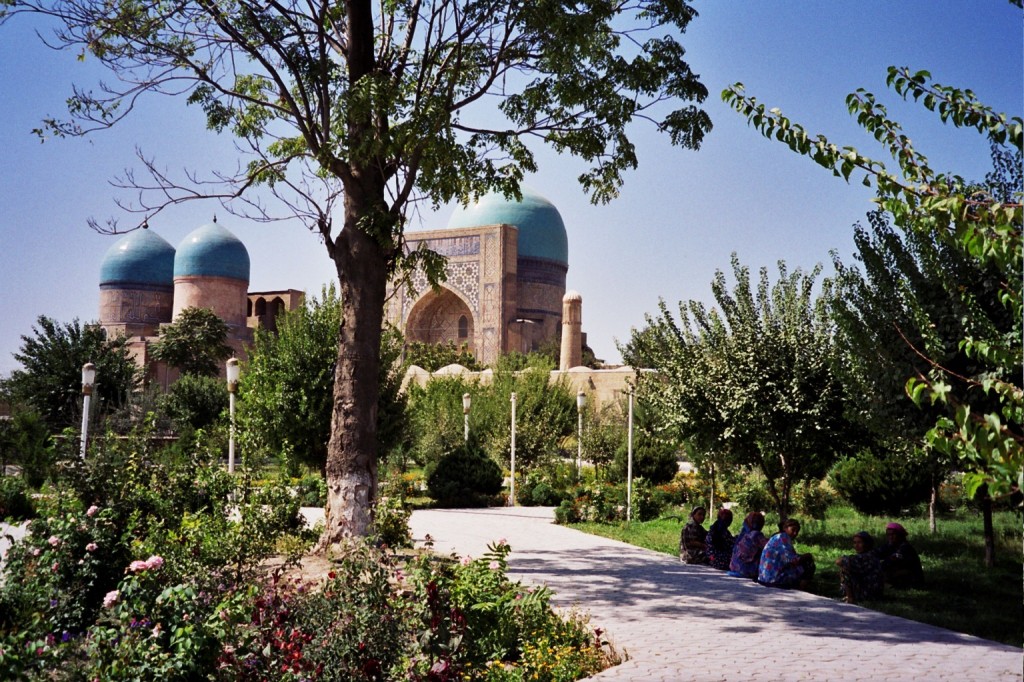
Means “green city” in Persian, Shakhrisabz once was a major city of Central Asia. Located approximately 80 km south of Samarkand, the historic city’ center has preserved its original town plan and offers impressive monuments from 15th-16th century.


Located at the altitude of 622 m, Shakhrisabz was inscribed on the UNESCO World Heritage List. Notable monuments include: Aq-Saray Palace, Tomb of Timur, Kok Gumbaz Mosque, Hazrat-i Imam Complex, The Chor-su bazaar, caravanserai and the baths.

The land of magical lamps


Now we are presenting you Bukhara – the fifth largest city of Uzbekistan. Situated on the Silk Route, the ancient town is more than 2,000 years old. There are many reasons to visit this magical place. The city offers superb historical monuments and a lively trade, every traveller finds something unique in this town.


The historic center of Bukhara is in effect an open-air museum displays many masterpieces of 10th-century Muslim architecture. It has been listed by UNESCO as a World Heritage Site. Major sights are: Fitzroy Maclean, Po-i-Kalan complex, Kalan Mosque, Mir-i Arab Madrassah, famous tomb Ismail Samani, Chashma-Ayub mausoleums, Lab-i Hauz.

Crossroads of Cultures


The historic town of Samarkand is the second largest city in Uzbekistan. Founded in the 7th century B.C the city is most noted for its central position on the Silk Road between China and the West. It is considered as a crossroad of the world’s cultures.


The major monuments include the Registan Mosque and Madrasas, Bibi-Khanum Mosque, the Shakhi-Zinda compound and Ulugh-Beg’s Observatory. In 2001, Samarkand was included in World Heritage List by UNESCO.

Plovdiv Praying


Saint Petka is old Orthodox Church picturesquely situated amidst the rocks on the southern slope of Djambazteppe, Plovdiv, from where it dominates the residential quarters, built on the flat country, in spite of its modest dimentions (28 x 16m). Two unique icons are preserved here also, dates back to the 13th century.


The Holy Virgin Cathedral is situated on the northern slope of Taximteppe, possibly in the place of a medieval monastery church (9th-10th C.). The year when the first church was built is unknown, but it is dated back to the middle of the Byzantine epoch. The bell-tower built in 1880-1881. Saint Marina Orthodox Church – A bishop’s church, the main one for the whole of the Plovdiv Eparchy. Situated at the southern foot of Taximteppe. The iconostasis is one of the most precious monuments of the wood-carving art on our land 1828, which is 21m long. The unique six-storied wooden bell-tower, built in 1870 and 17 m high, is also valuable.


St St Constantine and Helena – built in the place of an early Christian sanctuary, initially having been dedicated to Severian and Memnos, who perished for their faith together with 38 Plovdiv martyrs, murdered at this place during the reign of Emperor Diocletian (at the beginning of the 6th century). Later it was dedicated to the equal to the Apostles St St Constantine and Helena.

Ancient Plovdiv


The Roman Epoch (1st-6th C.) represents a peculiar golden age in the development of the antique Plovdiv, Bulgaria. Time when its ancient town structure took shape, including splendid public buildings, an enormous forum, an impressive stadium, a beautiful amphiteather, heathen temples, aqueducts, aristocratic houses, imposing fortress walls.


The Aqueduct of Philippopolis was built in order to supply the city with drinking water from the springs of the Rhodope Mountains. The total length of the construction is nearly 30 km. In the square of the west of Djumaya mosque the imposing remains of Philippopolis’s Ancient Stadium were discovered. The dimensions of this huge building are: length 1 000 Roman steps, width – 250 Roman steps. The Ancient Stadium accommodated about 30, 000 spectators and was one of the most significant architectural works in Philippopolis.


The Ancient Forum, the civic center of Philippopolis, covers an area of 20, 000 sq m in the heart of the ancient city. The Odeon is situated in the north-eastern corner of the ancient theatre building. This magnificent architectural specimen was built in the early second century AD during the reign of Emperor Trajan. As an element of the city square of the Roman period, the building served as the city council chamber of Philippopolis. Today, the theatre is an attractive cultural venue, where modern arts interact with the intransient values of the past.