Travel Guides for destinations worldwide. Our Travel Guides are the most comprehensive travel guides on the written by professional travel experts
Showing posts with label UNESCO. Show all posts
Tuesday, December 13, 2011
The most beautiful opera houses in the world
Opera de Monte Carlo
Located in the principality of Monaco, the Opera de Monte Carlo was opened in 1879. Designed the magnificent and extravagantly, the opera house was recently renovated. Over 80,000 gold leaves were applied to paintings and moldings, a five-ton chandelier has been entirely rebuilt. As it seats only 524, it is often difficult to get tickets. This the only opera house in the world to feature exterior views (thanks to the windows overlooking the Mediterranean) from within the concert space.
Teatro di San Carlo
Located in Naples, this is the oldest opera in Europe that has never closed the door. Opened on 4 November 1737 and then it was the largest in the world with its 3300 seats. Teatro di San Carlo is included in World Heritage by UNESCO.
The Mariinsky Theatre
Opened in 1860, this is pre-eminent theater is located in St. Petersburg, Russia. Named after Empress Maria Alexandrovna, wife of Tsar Alexander II and there is a bust of the Empress in the main entrance foyer. The building was severely damaged during the 900-day Siege of Leningrad, but later restored in 1944. With its marvelous 1,625-seat auditorium it is one of the greatest world class music theatres.
Bavarian State Opera
Built in 1818, Bavarian State Opera is located in Munich and features an impressive exterior and a magnificent interior. Destroyed in World War II it was moved to another place and built in its original form. Re-opened in 1963, the State Opera seats 2,100 people. Today the opera is among the most famous in the world.
Teatro Amazonas
This opera is in the heart of Manaus, deep in the Amazon rain forest of Brazil. Opera House was constructed during the Belle Epoque – the era of rubber that makes Manaus one of the most prosperous cities on the continent. The dome of the opera is covered with 60,000 ceramic tiles imported from France and currently has 701 seats
Romanian Athenaeum
This concert hall is one of the most beautiful buildings in Bucharest. It was built in 1888 in neoclassical style by architect Albert Galeron and considered as one of the architectonical jewellery of Romania. The auditorium (28, 50 m in diameter and 16 m high) having a special acoustics, seats 600 in the stalls and another 52 in loge seating.
Labels:
Arts,
Asia,
Brazil,
Cities,
Cultural,
Europe,
Germany,
Italy,
Monaco,
Monuments,
Romania,
Russian Federation,
South America,
Travel Stories,
UNESCO,
Urban Tourism
Monday, December 12, 2011
The Valley of Flowers – magic land of peace of mind
Valley of Flowers is extremely beautiful valley located high in the Western Himalayas, India. Described by climbers and botanists for over a century, this extremely diverse terrain is home to over 500 many rare and endangered species, including Himalayan brown bear, snow leopard, baralat (Himalayan blue ram) and more.
The national park stretches over an expanse of 87 km² the reserve and it is situated at an altitude of 3500 – 4000 m. Almost inaccessible to tourists due to the high altitude, the park is still considered one of the most beautiful places in the world. Getting to the Valley of Flowers requires a trek of about 17 km (Grade : Moderate) – a dream for all explorers. The park is in the UNESCO World Network of Biosphere Reserves since 1988.
The park is home to huge variety of fauna and flora including musk deer, red fox, Himalayan Golden Eagle, Snow Pigeon etc. and a huge variety of butterflies. The flowers include mostly orchids, marigold, daisies and anemones but 31 species are recognized as endangered species, while 45 others are medicinal plants, applied daily by local residents, including Dactylorhiza hatagirea, Picrorhiza kurrooa, Aconitum violaceum, Polygonatum multiflorum, Fritillaria roylei and Podophyllum hexandrum.
The best preserved Roman city in the world
The most interesting thing in Libya is not a conflicting image of Muammar Gaddafi. In the center of the cradle of civilization will find ancient history and outstanding nature. The ancient city of Leptis Magna was one of the most prominent and cities of the Roman Empire. Its ruins are located in Al Kums, Lebanon – 130 km. east of Tripoli.
The city probably was founded in the 6th century BC by Phoenician colonists under the aegis of Carthage and became a major force in the Mediterranean. Lebanon is not an easy country to visit, but the magnificent Roman site of Leptis Magna makes it well worth the effort. The city remained under the dominion of Carthage to the end of the Third Punic War and then passed to the Roman Republic. At the time of Julius Caesar in the city live 100 000 people. Leptis contains some of the world’s finest and well-preserved remains of Roman architecture in the Mediterranean. In 1982 it was designated a UNESCO World Heritage site.
The birthplace of Nicolaus Copernicus
One of the oldest cities in Poland, the medieval town is the birthplace of Nicolaus Copernicus. In 1997 the history center of the city was designated a UNESCO’s World Heritage Site and the Old Town was added to the list of Seven Wonders of Poland.
Archaeologists have discovered that the first settlers in the area were over 1100 BC. In 1230 Teutonic Knights built a castle on the site. In 1263, Franciscan monks settled in the city, and after them, and Dominicans. As you can see, the town is very attractive. Torun has the largest number of preserved Gothic houses in Poland. The most interesting monuments are: The Cathedral of SS. John the Evangelist and John the Baptist, The Old Town Hall, begun in 1274, City fortifications, begun in the 13th century, Ruins of 13th-century Teutonic Knights’ castle, and many more.
Thursday, December 8, 2011
The Mosque of Uqba
It is one of the most important mosques in Tunisia. Located in the UNESCO World Heritage town of Kairouan, it is also known as the Great Mosque of Kairouan. The Mosque of Uqba was built by the Sahabi, Uqba ibn Nafi from 670 CE and became an important center for Islamic and Quranic learning.
The Great Mosque of Kairouan is the oldest Muslim place of worship in the western Islamic world. Spreads over a surface area of 9,000 sq. m it attracts a large number of Muslims from various parts of the world. It is commonly regarded as the fourth holiest site in Islam (after Mecca, Medina, and Jerusalem). For more additional information click here.
Tuesday, December 6, 2011
More Uzbekistan
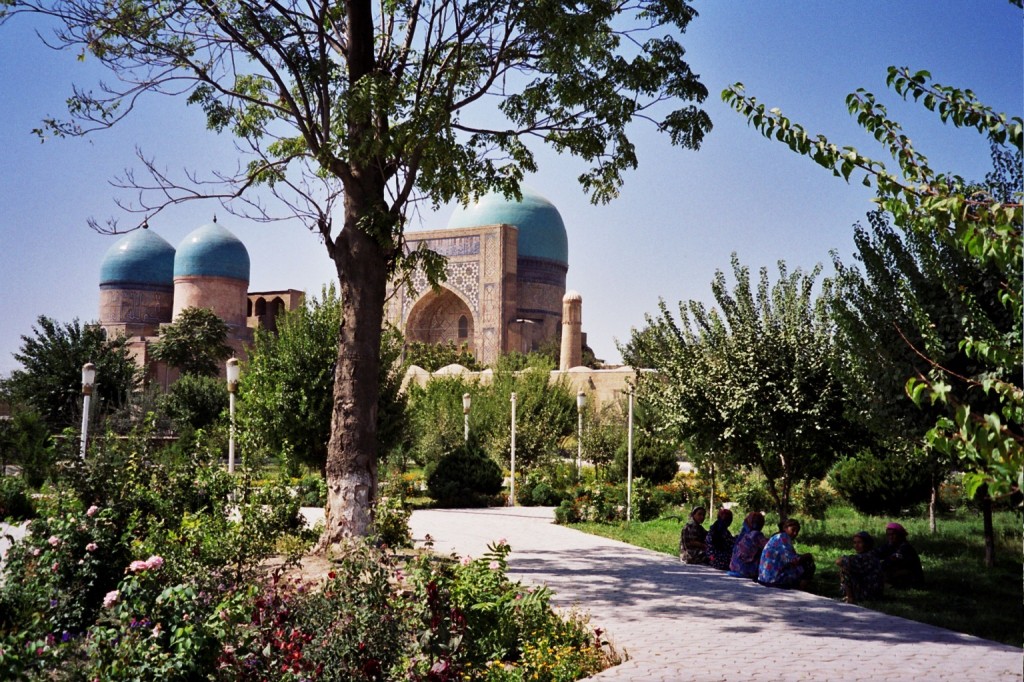
Means “green city” in Persian, Shakhrisabz once was a major city of Central Asia. Located approximately 80 km south of Samarkand, the historic city’ center has preserved its original town plan and offers impressive monuments from 15th-16th century.
Located at the altitude of 622 m, Shakhrisabz was inscribed on the UNESCO World Heritage List. Notable monuments include: Aq-Saray Palace, Tomb of Timur, Kok Gumbaz Mosque, Hazrat-i Imam Complex, The Chor-su bazaar, caravanserai and the baths.
The land of magical lamps
Now we are presenting you Bukhara – the fifth largest city of Uzbekistan. Situated on the Silk Route, the ancient town is more than 2,000 years old. There are many reasons to visit this magical place. The city offers superb historical monuments and a lively trade, every traveller finds something unique in this town.
The historic center of Bukhara is in effect an open-air museum displays many masterpieces of 10th-century Muslim architecture. It has been listed by UNESCO as a World Heritage Site. Major sights are: Fitzroy Maclean, Po-i-Kalan complex, Kalan Mosque, Mir-i Arab Madrassah, famous tomb Ismail Samani, Chashma-Ayub mausoleums, Lab-i Hauz.
Crossroads of Cultures
The historic town of Samarkand is the second largest city in Uzbekistan. Founded in the 7th century B.C the city is most noted for its central position on the Silk Road between China and the West. It is considered as a crossroad of the world’s cultures.
The major monuments include the Registan Mosque and Madrasas, Bibi-Khanum Mosque, the Shakhi-Zinda compound and Ulugh-Beg’s Observatory. In 2001, Samarkand was included in World Heritage List by UNESCO.
The Ciudad Universitaria de Caracas
The Ciudad Universitaria de Caracas is the main Campus of the Central University of Venezuela. Designed by the Venezuelan architect Carlos Raúl Villanueva between 1940 and 1960 it is an outstanding example of the modern avant-garde ideas in architecture.
Consists of forty buildings in nine groups or zones, this vast urban complex covers an area of about 2 km². The complex also includes masterpieces of visual arts, like the “Clouds” of Alexander Calder, the Olympic Stadium, and the Covered Plaza.
Considered a masterpiece of architecture and urban planning it is one of the most successful applications of Modern Architecture in Latin America. This is also the only university campus declared as a World Heritage Site by UNESCO (in 2000).
Labels:
Arts,
Cities,
Cultural,
South America,
UNESCO,
Urban Tourism,
Venezuela
Subscribe to:
Posts (Atom)